Tuesday, 11 November 2014

The Biberach Tunnel Break - Part Four

Shutterstock.com

Duncan’s leg was painful, but at least he could stand and walk. The other side of the ditch was almost vertical and he struggled to climb out of it. T/Captain Barry O’Sullivan would already be at the rendezvous by now and growing impatient. Time was vital and every delay meant less distance between the escapers and camp before the alarm was raised. As Duncan scrambled out and limped towards the meeting place, he must have speculated on the leg injury and cursed his carelessness in allowing the fall to happen. Most of the journey would be on foot. A leg or foot injury was every escaper’s nightmare.

‘Heinrich, Heinrich, where the hell are you?’ (As neither man spoke German, O’Sullivan called out his fellow escaper’s agreed code name {See earlier post} ). Duncan recounted what happened next.

‘I’m terribly sorry Barry. . I fell down a ditch and damaged my leg. You’d better go on by yourself and I’ll follow in my own time. I’ll make it alright, slowly.’
 
O’Sullivan ignored this. ‘We must get cracking’ he said leading off into the forest. ‘Half the others have gone already.’ Duncan limped after him.
 
The agreed plan between the two men was to journey entirely on foot, keeping away from all contact with others if possible. Trains or any other form of public transport were to be avoided as neither man spoke German. They had agreed to travel their prearranged route together for the first three days and then go their own ways. This largely fitted into the overall strategy of all twenty six escapers. They had  chosen their own  routes into Switzerland to avoid the whole party travelling in exactly the same direction. The paths varied, ranging from travelling around the east of Lake Constance or east of Schaffhausen, to moving west. Some were making for points as far away as Basle.


Schaffhausen - nostalgie-foto.ch

Lake Constance - present day
 
We’ll go north for the first night’ said O’Sullivan. ‘They’ll be expecting us to go south, so if we go in the opposite direction, we’ll fox them. Then we can turn west and finally south. It’ll make the journey a lot longer, but I think it’ll be worth it….we must move in the dark and avoid contacts.’
 
They hurried along the forest tracks for the first two hours, reaching the road from Biberach to Attenweiler .  O’Sullivan always strode on ahead and the psyche of the two men is well illustrated during the early stages of their escape. Duncan observed that his travelling partner had a formula if he were not quite sure of where he was. ‘We must keep cracking on old boy. We can get our direction tomorrow.’

Attenweiler - panoramio.com

O'Sullivan had shown numerous instances in the past of his desire to forge on first and let the rest take care of itself. A typical example was during the tunnel excavations, when in the middle of August he returned from a spell in the camp hospital and as Duncan noted at the time:

' breathing fury at being kept away from the work so long and determined to do twice as much as anyone else.'

On the first occasion O'Sullivan went down the tunnel, large amounts of earth came back in double quick time. It was only after he was finally persuaded to come out for the next man to take over that his over zealous digging with a poker was discovered. O'Sullivan had lost direction and hollowed out a large dome in the roof of the tunnel. This became known by the diggers as 'The Cathedral' (see Part One)
 
As the two men journeyed, Duncan seemed to assume a more cautious, ordered and less hopeful approach. At this stage he was prepared to let O’Sullivan take the lead.
 
‘I had decided to keep a diary of our wanderings with the rather pessimistic idea that, if we were captured, the information on the country might be useful to subsequent escapists. To start with, it was concerned mostly with comments on roads, types of country and water points, but as time went on and I gained confidence, it became more and more of a narrative.’
 
The escapers needed to achieve maximum distance from the camp before daylight, whichever route they had chosen. Although it had been agreed to avoid all roads and to travel across country at night, both men were sure that taking the highway in the direction of Attenweiler was worth risking under cover of darkness as the breakout was unlikely to have been discovered yet. The road was also lined with apple trees which helped add to their rations.
 
By 04.30 Duncan was exhausted and struggling with the pain in his leg, but O’Sullivan insisted on continuing for a further hour before hiding up in a wood for the day. Although the date was 14 September, the weather had already started to deteriorate, with temperatures dropping at night. Description from the diary gives a vivid picture of how uncomfortable conditions were for the escapers. They lay all day in a spruce wood, lying in wet clothes on a bed of branches and surrounded by a camouflage screen. The damp had ruled out any chance of drying the clothes and during the afternoon a group of men and boys had beaten their way through the wood. Pestered by mosquitoes, the escapers lay still and were left unsure whether the party had worked their way through to flush out game or were searching for escaped POWs. Fortunately the dogs had been left outside and the pair remained undiscovered. In a single sentence in his diary Duncan’s thoughts encapsulate the mind of a POW fresh on the run:

‘It’s almost impossible to believe we’re free – if only for the moment.’
 

To be continued
 

Sources and Additional Reading
 
Underground From Posen - Michael Duncan  (Highly recommended read)

Author's Notes
 
* I would like add some photographs of any of the 26 men from the Biberach Tunnel escape. If anyone can help on this, I would hugely grateful if they could contact me.  

©Keith Morley
 
THIS BLOG claims no credit for any images posted on this site unless otherwise noted. Images on this blog are copyright to its respectful owners. If there is an image appearing on this blog that belongs to you and you do not wish for it appear on this site, please message me with a link to said image and it will be promptly removed
 

Thursday, 18 September 2014

The Biberach Tunnel Break - Part Three


Typical German Guard Tower
 
Continued from previous post

The plan for leaving the tunnel stipulated that each man should go out at five minute intervals. This would minimise the amount of movement visible from the towers, searchlights and guards patrolling the perimeter fence with their dogs. It also gave each man a chance to get away in the event of the person following being discovered. No more than two personnel would be moving across the open ground at any one time.
 
Many of the escapers applied crude forms of camouflage – some by sewing grass on their clothes, others darkening their outfits and covering faces and hands with blacking. Michael Duncan had obtained a large net big enough to cover his whole body. To this he attached tufts of grass. The POWs involved in the escape had prepared their maps, compasses and clothing long before the tunnel was completed. Red Cross parcels were arriving with some regularity and it had been easier to accumulate food suitable for long term storage. Duncan described his rations for the journey as:

‘4.5 lb of chocolate, 2.5lb of cheese, 1lb German ration biscuits, 1.5lb mixed dry oatmeal, glucose and a water bottle.’
 
Red Cross Parcel - Daily Telegraph


The final exit order from the tunnel was decided by drawing lots. Each one related to a pair of escapers, whether or not they would be travelling together once the break was made. The only predetermined positioning was that of Duncan who exited first, followed by Temporary Captain Barry O’Sullivan. Neither of the two men wanted this, as despite the amount of work they had carried out in leading, planning, digging and shoring the tunnel project, they sought no privilege. The rest of the party insisted that the two men went first and O’Sullivan was adamant that Duncan should exit before him.
 
It is strange that that some escapers had never set foot in the tunnel before the night of the breakout because they were members of the other tunnel project which had not yet been completed (see previous post). Also certain POW’s had been solely involved in other areas of the ‘end to end’ process:

Passing up soil into the hut from the tunnel entry shaft (This had usually been excavated at the tunnel face and ‘trollied’ down in half a biscuit tin mounted on wheels.)

Lifting the cardboard box containing soil up to a POW standing on a locker, who would then pass it to the man inside the roof space for stowing.

Acting as a lookout or stooge and assisting with the rapid cover up operation in the hut in the event of a guard, ferret or search party approaching.
 
On the night of the escape, four men were to be in the tunnel at any one time. One waited at the exit, one at the Cathedral (see previous posts re The Cathedral), one in the chamber and one at the entrance. Duncan had taken up position at the exit ready to break through and O’Sullivan was in the Cathedral. The two men had planned to meet half a mile from the camp where a road entered a wood. If it became necessary to call to establish contact, Duncan would be ‘Heinrich’ and O’Sullivan ‘Karl’. Neither man spoke any German.     
 
‘As soon as I had made a small hole the cold night air gushed in…and the rain which had started to fall splashed on my face.’
 
Duncan accidentally dropped his knife during trying to make the exit hole larger, which slowed the whole operation. The men down the tunnel grew impatient as he tried to tear away tufts of grass with his hand. O’ Sullivan arrived behind him, and by chance in the total darkness Duncan’s hand located the knife and work began  at full speed again. It took two hours to get the exit hole wide enough for a man to get through.
 
He described what happened as he made his move:
 
‘I wormed my way out and lying flat, I crawled away from the hole. After a few yards I stopped, spread my camouflage net over me and looked around to get my bearings.’
 
The tunnel had exited right on top of the crest of an incline which had blocked the view from inside the camp as to the state of the ground beyond. The terrain was open and level rather than the decline that the escapers had predicted. Duncan calculated that there would be a good hundred yards to crawl before they were out of range from the searchlights.

Tunnel Exit as photographed in 1981 (larger than the original)
- www.prisonerofwar.co.uk

Opening the tunnel exit had taken more out of him than he realised. His arms were weakened and crawling became very slow and painful.
 
‘Once a searchlight came on, sweeping across the field. I lay still under my net and the light passed over me without stopping and went out. Soon I saw, away to my right a small light close to the ground. It was moving very quickly and soon passed by.’
 
He realised that it was the glow from a luminous watch and a further figure crawled past him. The five minute interval plan had clearly been ignored.
 
Eventually he reached the cover of a ditch and some bushes. Standing up to get some bearings, he calculated that he had strayed further to the left than planned which had cost valuable time. It was doubtful that O’Sullivan would wait for long at their rendezvous point, so Duncan got his bearings and hurried towards the location. Dogs began barking and he broke into a run across a field towards the wood.
 
‘Suddenly I felt myself falling and as I hit the bottom a sharp pain stabbed at my left ankle and knee. …I found that I had fallen down a large and deep irrigation ditch.’
 
To be continued

 
Sources and Additional Reading

Underground From Posen - Michael Duncan  Highly recommended read


Author's Notes

©Keith Morley
THIS BLOG claims no credit for any images posted on this site unless otherwise noted. Images on this blog are copyright to its respectful owners. If there is an image appearing on this blog that belongs to you and you do not wish for it appear on this site, please message me with a link to said image and it will be promptly removed


Thursday, 28 August 2014

The Biberach Tunnel Break - Part Two

Biberach Camp pictured later during the war - Guernseybiberach.com

Continued from previous post:

Lieutenant Michael Duncan was stuck fast between two boulders in the escape tunnel. He had led and driven this project, spending more time excavating soil, and shoring up the workings than any of the other diggers on the team. Panic set in as Duncan found he was unable to move forwards or backwards. He recalled:
 
‘…but at last I calmed down and by careful wriggling got free.’
 

The Biberach tunnel was less than half the width and height of The Great
Escape tunnel shown in this sketch -  prisonerofwar.org.uk

It would be natural to assume that all 26 prospective escapers had been involved in the digging or tunnel project at some stage. This was not the case. The original team consisted of 10 men who formed the digging party. As the tunnel was very narrow, only limited numbers could work in it at any one time. At the beginning, there was room for only one person and throughout the project there was only one digger at the face. As the tunnel progressed, they had a small chain of support coming from behind.  It was decided that personnel on the team not involved in the digging work at any given time would act as ‘stooges’ (look outs).
 
Soil from the tunnel was stored in the roof space of the hut. The heat was so excessive in that space that a team of men had to take it in turns working short stints. An additional four POW’s joined the group to work solely on the stowing operation. They did not dig in the tunnel, as this work was too exacting on top of what they were already doing. The stowing group functioned as a three man operation, with the fourth acting as lookout or general support whilst not engaged in the physical work:
   
Man One would collect the cardboard box containing the soil, which had already been passed up into the hut from below. He passed the box to Man Two standing on top of a locker.

Man Two would pass the box up to Man Three who was waiting in the roof space to spread and store the earth.
 
When the tunnel was finished, the team waited for a suitable cloud covered or moonless night. It was then that Duncan suddenly remembered an agreement made at the beginning of the project which had been forgotten.
 
They had obtained permission from the Escape Committee to start their tunnel whilst another was already under way. The agreement had been that whoever completed first must then allow the men working on the other tunnel to leave in line before them.  Looking back at events, this seemed a strange arrangement. Duncan’s co-leader, Temporary Captain Barry O’Sullivan advocated that they should not be held to that agreement as their team had started work after the other tunnel project and yet still completed first.
 
Duncan went to the head of the Escape Committee.
 
‘We’re all ready to go sir, as soon as we get a decent night. You’re not going to hold us to our promise to let the others go first are you?’
 
‘I must’ said the Head. ‘I gave them my word. But I’ll have a talk with them.’
 
The Biberach tunnellers worked from underneath the location of  a stove in
hut 6 - prisonerofwar.org.uk 

The other tunnel was nowhere near completion and a compromise was reached. Duncan’s party had increased over time to nineteen, but one of those was in the camp hospital and not fit enough to take part in the escape. The Head advised that if Duncan was ready he could go, but would have to take the ten leaders of the other tunnel project with him. Duncan suggested that once his team were out, anyone could make use of the tunnel. The head was unmoved.
 
‘I don’t think that’s wise. If too many try to get out, someone’s sure to be spotted and that’ll spoil the chances for everyone. …I think twenty five should be the maximum number. If they leave at five minute intervals, it’ll take just over two hours to get them all out – say two and a half to allow for accidents. That’ll give them a chance to get clear by daylight.’
 
Duncan queried that if ten of the other team were included in this number, it would mean three of his own men would miss out on the escape, which was unfair. He suggested that the number be increased to twenty six, as there was no little chance of the other tunnel being completed before all of the POWs were transferred to a new camp, which was imminent.      
 
This must have been bitterly disappointing for Duncan and the men. They had worked so hard as a team and had completed before the other tunnel. They now faced the prospect of two of their own not being able to leave. Duncan had also envisaged larger numbers escaping by way of other POWs using the tunnel after their party had exited. He could however see the head of the Escape Committee’s logic.
 
The next problem was how to arrive at the two POWs who would not be going. Drawing lots amongst the whole team was unfair as some had completed huge amounts of work and would then run an equal chance of not being selected. Conversely, to select a given number of men from within which the lots would be drawn was equally unjust. A secret ballot amongst the whole team was taken where everyone voted on the two who should be excluded. The lot fell on a member of the guard party and one of the men who stowed the soil. They were given the bad news and told they would become members of the other tunnelling party and leave by that exit once it was completed. In reality this seemed an empty compensation which was unlikely to materialise. 
 
As Duncan reached the end of the tunnel and the final shored up exit point, he had been forced to accept the way things were. The whole focus now was on pushing through the last few inches of grass and breaking out for freedom.

 To be continued
 
Sources and Additional Reading

Underground From Posen - Michael Duncan  Highly recommended read


Author's Notes

©Keith Morley
THIS BLOG claims no credit for any images posted on this site unless otherwise noted. Images on this blog are copyright to its respectful owners. If there is an image appearing on this blog that belongs to you and you do not wish for it appear on this site, please message me with a link to said image and it will be promptly removed

Monday, 18 August 2014

The Biberach Tunnel Break - Part One

Oflag Vb - www.prisonerof war.org.uk

At 8.45 pm on September 13th 1941 the POWs planning to escape from Oflag Vb, Biberach met in hut 6. Recent nights had seen a full moon with clear skies and almost floodlight visibility. This ruled out any possibility of a breakout, but towards the evening of the 13th a strong breeze had started to bluster around the camp. Thick black clouds gathered and now the men mulled over whether this would be the night to make their move.
 
An escape tunnel had been completed a few days before this, after months of work. Only the last nine inches of earth to the surface remained at the exit end. The men had shored up this part with a one inch thick piece of plank, but a neighbouring farmer had decided to cut a second crop of hay in the field near to the camp, including the edge where the final section of the tunnel was situated. Initially, this suited the men, as the swathes of grass would give extra cover when they moved across open ground and any cut areas would make crawling easier.
 

Diagram of Oflag Vb - M Duncan.

A problem arose on the morning of the 13th as heavy wagons were brought in to move the hay. These regularly trundled over the roof of the tunnel and the men watched anxiously from behind the wire. With the mountains of neutral Switzerland visible and only 68 miles away, these were tense times. Months of careful planning and work would be lost if the tunnel collapsed.
 
The entire operation had been a magnificent achievement. Oflag Vb was originally built as a barracks and consisted of long low brick huts built around a parade ground. At one end was an extra open space for exercise purposes and the whole area was surrounded by a standard double fence of thick barbed wire, ten feet high with a six foot gap between the two fences, filled with short lengths of the same type of wire. This created an impenetrable perimeter; although the construction was overcome with ladders in another camp (see earlier post on the Warburg Wire Job).
 
At every corner or bend in the fence, a raised sentry tower with machine gun and searchlight was strategically positioned. Three feet inside the main wire was a low single length of thin wire which was the closest that POWs were allowed to venture in terms of the perimeter. Anyone stepping over the wire risked being shot. At night, guards with dogs constantly patrolled around the fence.   
 
A road ran parallel with the outer barbed wire fencing and beyond this was a six foot rising bank where at the top the ground continued up less severely on to a crest. The POWs decided to tunnel down, before gradually angling upwards beyond the crest, as this would conceal any exit from the camp searchlights. The disadvantage was the lack of a proper view beyond the crest.  
 
The team decided this had to be the night. For the 26 escapers, everything rested on a getaway during the hours of darkness. (See earlier post ‘Long Tunnel Schemes Part Two’ on 03 January 2014 for a general account of the tunnel and breakout.) Scheme leader, organiser and main digger Lieutenant Michael Duncan, 4th Battalion Oxford and Bucks Light Infantry entered the tunnel for the last time at 9.15 pm.
 
One foot nine inches by one foot six inches were the absolute minimum dimensions which tunnellers could realistically hope to work in. The Biberach tunnel ran for around 145 feet with these measurements, apart from:
 
 ‘The Rocks’ - a gap of only a foot between two immovable boulders.
 
‘The Depression’ – where the floor sank into a short recess at the point where full boxes of earth were pulled back.
 
‘The Cathedral’ – a spot where Temporary Captain Barry O’Sullivan, (fresh from a stay in the camp hospital due to blood poisoning) had been over enthusiastic with his digging and unknowingly carved a small dome in the roof as he excavated with a poker.
 
‘The Chamber’ – a ‘room’ wide enough for a man to turn around and high enough for a man to achieve a sitting position. This became a ‘half way house’ and control area for tunnel work.


Diagram showing tunnel points, path and trajectory - M Duncan

Diggers had usually worn only vest and pants when working in the passage. Duncan now faced a problem. With all his clothes on, it was a tight fit. Dragging his kit behind him (tied to his foot) he reached ‘The Rocks’ and described what happened next:
 
‘I came to the Rocks and there I stuck. My kit prevented me from going backwards and I apparently could not go forwards. I was beyond the range of The Chamber light, and in the dark, I sweated in uncontrollable panic. For a moment I was in absolute terror and seemed to be suffocating…’
 
To be continued

Sources and Additional Reading

Underground From Posen - Michael Duncan  Highly recommended read

Author's Notes


©Keith Morley
THIS BLOG claims no credit for any images posted on this site unless otherwise noted. Images on this blog are copyright to its respectful owners. If there is an image appearing on this blog that belongs to you and you do not wish for it appear on this site, please message me with a link to said image and it will be promptly removed


Friday, 8 August 2014

Oflag XX1B - A Home Run Part Two

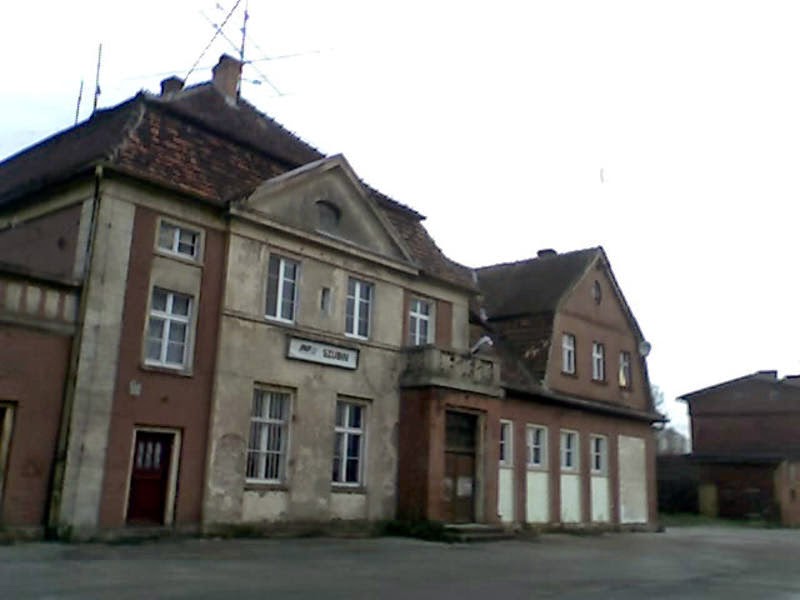
Szubin Rail Station  Pictured Present day
 
In continuation from last week’s post - late on 16 December 1942, RAF POW Philip Wareing made his third trip under guard to the Szubin railway station to collect supplies off a train (four escorts to every party of ten POW’s). In a staged accident, one of his fellow POW orderlies dropped a load of bread creating a diversion. The guards were momentarily distracted and Wareing slipped between the lorry that had transported the POWs to the station and a goods wagon. In the fading light he crawled under the wagon, rolled across to the other side, then raced over two sets of tracks and platforms. As he made a run for it, the lorry driver, who was a German soldier, started up his engine, which drowned out any warning shouts from station or public personnel on the other side on the wagon. The guards were unaware of what had happened.

If Wareing could get away undetected from the station and reach the woods and marshes outside Szubin he could hide up before making his next move. The odds were slim, as once his absence was discovered, searches would begin, with the entire area being put on alert. But he had one thing in his favour - darkness was closing in. He managed to sneak out of the station without attracting attention, and night fell as he left the village to make for the woods.
In his pockets Wareing carried the day’s ration of hard tack biscuits plus items from Red Cross parcels - a small lump of cheese, Horlicks tablets, sugar and a piece of chewing gum.

Standard Hard Tac Biscuit

He hid overnight in the wood, trying to get some rest in the intense cold. The distance to Bromberg  (now Bydgoszcz) was around 24 kilometres, and at 09.30 the next morning he set out to make the journey on foot. It passed without significant incident apart from the effects of cold. In the town he managed to find a bicycle which had been left unattended.  Walking casually along, he pushed it for a few yards, then rode off heading north in the general direction of Danzig.  

Bromberg Streets in 1940 -  fotopolska.eu

It is interesting how the lure of freedom shortened distances in the mind of the escaper. Wareing had a working knowledge of the area through camp intelligence and maps (see previous posts on how this operated). He had already walked 24 kilometres, and the journey ahead of him to Danzig was 166 kilometres. Travelling by public transport was to be avoided where possible because of checks and heightened security. He would cycle in the direction of Graudenz  (now Grudziadz) on the Vistula river and look for a ship flying the Swedish flag. 71 kilometres to Graudenz was a significant distance and the worn out machine had an uncomfortably hard saddle. Frequent dismounts were necessary on hilly sections and he had not reached his destination by nightfall. The moonlight was sufficient for him to continue travelling and Wareing took a chance, crossing a guarded bridge over the Vistula.  


Grudsiadsz -  fotopolska.eu

At 08.00 hours on 18 December, he  reached Graudenz. It was light and he cycled towards the docks to find a Swedish ship.  With hindsight, the odds of finding a neutral vessel on an inland river port such as Graudenz were remote, but had to be investigated. There were none. Wareing needed to leave the dock area immediately. Anyone acting suspiciously would be stopped and questioned. There was no possibility of waiting around or loitering on the streets. He decided to cycle over to the railway station and look for a train to Danzig. Travel on this route was extremely risky as it led to a major port and would be closely monitored. For an escaper who was cold, tired and hungry, with a long distance to cover on a rickety old bicycle, this was the next best option.  Nothing showed up on the departure boards. There was no choice but to retrace his route back to the guarded bridge over the river and get on to the Danzig road. Wareing knew that neither he nor the bicycle would stand up to the journey.


Grudsiasdz Rail Station - pomorska.pl

For an escaper or evader there were often watershed moments which shaped the pathway to either freedom or capture. Wareing soon spotted a man propping a pristine looking bicycle on a stand and seized the moment. The man had walked away leaving it unattended. There was no going back. Ignoring the risk of being seen and apprehended, the escaper took the new bicycle and rode off back in the direction of the Vistula bridge, leaving the boneshaker in its place. He crossed back over unchallenged whilst the guards were deep in conversation with two Germans in uniform.

It was still light when he saw a milk churn beside a farm gate and paused to take a drink. After snatching some sleep in a haystack, the journey restarted at 04.00 hours the following morning and continued throughout the day. He spent the night in an empty unfurnished house, narrowly missing the torch beam of a caretaker who was checking the premises.
The bicycle held up well. Despite surviving on minimal rations, Wareing reached Danzig the following day.  He slipped into the docks without being stopped by police or troops and spotted a Swedish ship being loaded with coal. Abandoning his bicycle, he hid by a timber pile before walking straight up the gangplank as if a member of the crew. Personnel on the ship seemed occupied with loading up the cargo and no one noticed him. Wareing found his way down into the hold unchallenged.

Danzig 1940 - gamek.pl


Port of Danzig - zegluga.wroclaw.pl
Cranes were dumping more coal around him until the hold was three quarters full. Some Russian POWs under German guard came aboard to trim the cargo. Wareing was spotted by one of the Russians, but after saying quietly ‘ Angliski pilot’ he was left alone.

Gothenburg 1940

A two hour routine search of the ship began in the early morning of 21 December before it was allowed to sail at 09.00 hours. The stowaway remained in the hold for two days before venturing on deck. He was immediately seen by a member of the crew who returned him to the hold. For the following two days of the voyage Wareing survived on bread and water brought to him by the sailors. The captain was eventually informed and upon arrival at Gothenburg  handed him over to the Swedish police , who notified the British Consul. A full set of decent clothes was provided and he stayed at Police Headquarters, being allowed out in the day until a member of the British Embassy took him to Stockholm on 28 December. On 5 January 1943 he was flown back to Scotland. For his display of initiative, resourcefulness and courage he was awarded the Distinguished Conduct Medal.  


Sources and Additional Reading

Home Run - Richard Townshend Bickers
Author's Notes

©Keith Morley


THIS BLOG claims no credit for any images posted on this site unless otherwise noted. Images on this blog are copyright to its respectful owners. If there is an image appearing on this blog that belongs to you and you do not wish for it appear on this site, please message me with a link to said image and it will be promptly removed


Friday, 1 August 2014

Oflag XX1B - A Home Run Part One

 
RAF Kenley 18 Aug 1940  from a Luftwaffe bomber
 

Three months before the Asselin Tunnel breakout, Oflag XX1B had its first successful home run. Sergeant Philip Wareing became the only pilot shot down over France during the Battle of Britain to escape from a prison camp and make his way back to Britain.
Wareing had joined the RAF Volunteer Reserve in early 1939 and was posted to 616 (South Yorkshire) Squadron which moved to Kenley on 19 August 1940. The squadron was equipped with Spitfires and on 22 August Wareing shot down his first enemy aircraft. On the evening of the 25th   he was scrambled for his third operational sortie of the day to intercept a hundred bombers and escorting fighters which had attacked Dover and the Thames estuary.


616 Squadron scramble at Kenley in late August 1940


Hurricanes and Spitfires met the raiders mid channel. Wareing shot and damaged a Messerschmitt 109 which he chased back towards France. Not realising how close he was to the French coast, his Spitfire came into the range of enemy flak defences and was badly damaged forcing him to bale out. He landed near to Calais Marek aerodrome and was quickly surrounded by German troops.

Sergeant Philip Wareing standing far right
 
By the time he was transferred to Oflag XX1B POW camp (Szubin) in September 1942 Wareing had been in captivity for over two years. A short spell in Goring’s ‘model camp’ at Stalag Luft 111 Sagan from April 1942 had made his mind up to look for a change of scene and fresh opportunities for escaping. Oflag XX1B was a camp for officers, but as Wareing was an NCO he was not eligible for transfer. He solved this problem by volunteering as an orderly to the officers and was accepted.
Part of the camp was a former school, with the Army and RAF NCOs being housed separately from the officers in the converted stables. Living conditions throughout Oflag XX1B were basic (see previous posts) and the prisoners started to look for ways of escape. From reports and first-hand accounts, Wareing seems to have acted with no involvement in any of the officer’s schemes. There was always the division of rank and separate accommodation which kept a distance between the men. It was a natural evolution for the NCO’s to work with each other. One certainty was that any plan hatched would have been submitted and authorised by the Camp Escape Committee (see previous posts on a typical camp escape organisation).
Wareing quickly learned from other prisoners that many Polish civilians harboured such a hatred of the Nazis that they were prepared to risk everything for the Allied cause. For the ‘would be’ escaper this was a vital piece of the jigsaw, both inside and outside of the wire.


Entrance to Szubin Camp

He equipped himself ready to take a chance with any snap opportunity which arose. To pass his clothes off as civilian, he had loosened the stitching around the pockets of his tunic, pilot wings and sergeant’s chevrons, so they could be quickly torn off. He had already changed his blue trousers to an old pair of khaki Army ones and also wore Army boots which he had acquired. Some old RAF trousers had been cut up to make a cap, and carefully hidden in his pockets were shaving kit, a comb and mirror along with a homemade compass and three maps which had been drawn in the camp. Wareham always tried to carry these items with him. 

The orderlies were regularly taken out of camp to the railway station under heavy guard to collect rations, coal and Red Cross parcels. The ratio of one escort to every two POWs meant that there was little chance of making a break, but with model behaviour by the orderlies the number was reduced to four guards against every ten prisoners. The time taken to achieve this relaxation was used wisely, with intelligence gathering by the POWs when at the railway station and travelling to and from the camp. Work practices and observations of the guards were discreetly noted and examined for weaknesses and potential escape opportunities. 


Szubin railway station pictured present day

Late on 16 December 1942, Wareing made his third trip to the station since the new guarding arrangements had been implemented. He had a plan. In a staged accident, one of his fellow orderlies dropped a load of bread he was carrying, creating a diversion. It was time for Wareing to make his move.

To be continued..

Sources and Additional Reading

Home Run - Richard Townshend Bickers
Moonless Night - B A 'Jimmy' James
Under the Wire - William Ash
Author's Notes

©Keith Morley

THIS BLOG claims no credit for any images posted on this site unless otherwise noted. Images on this blog are copyright to its respectful owners. If there is an image appearing on this blog that belongs to you and you do not wish for it appear on this site, please message me with a link to said image and it will be promptly removed